Our Members' Blogs

Showing posts with label Contemplative Life. Show all posts

Wednesday, May 14, 2014

Finding our supernatural home

 By David Torkington


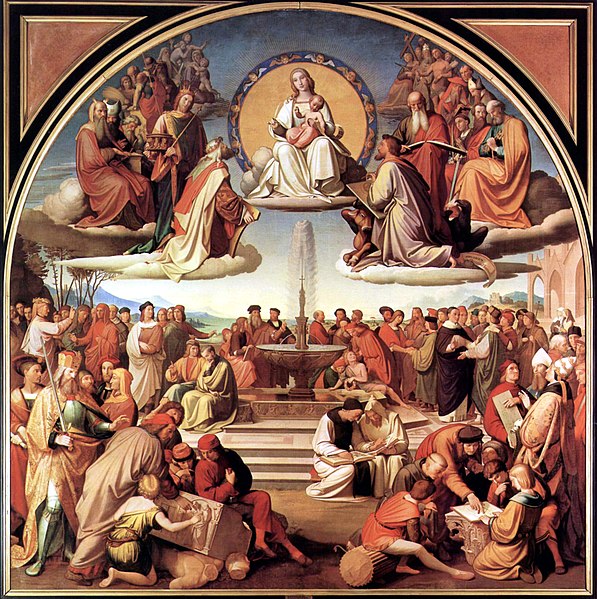
File:Friedrich Overbeck 001.jpg
The Triumph of Religion by Overbeck (Wikimedia Commons)


As a  person tries to observe the  new commandments by making acts of love through all they say and do, they are  gradually able to rise step by step towards journey’s end. Their progress is made possible, because it is made in, with, and through Christ who claimed to be the vital living embodiment of Jacob’s mystical ladder (John1:51). He is The Way, The Truth, and The Life (Jn 14:6). He is  the way to our destination, the Truth who both reveals and  embodies that destination, and the eternal life that constitutes that destination.

The journey stretches from here to eternity where the traveler finally enters into  a profound and ongoing Holy Communion with the One who dwells in the eternal ecstatic joy, that flows from the  mystical  vortex of loving that constitutes God’s very being. Faith in what is to come, is fortified by hope that is derived from the tangible experience of the  love enjoyed  in the profound intimate Holy Communion, that has already begun here and now. These gifts are given as  the new commandments are put into practice day by day:-

No More Homeless, No More  Orphans!

 That is why Jesus promised that we would not be left orphans, because through the Holy Spirit, the Father and the Son would make their home within us here and now:-

I will not leave you orphans I will come back to you. (Jn 14 :18)  

“If anyone loves me he will keep my commandments and my Father will love him and we shall come to him and make our home within him.”(John 14:23-24)


Read the rest at David's blog David Torkington.

Wednesday, February 26, 2014

The value of the contemplative life

Barbara A. Schoeneberger


Christ in the House of Martha and Mary 1570-1575, Tintoretto, oil on canvas, Alte Pinakothek, Munich
Christ in the House of Martha and Mary
by Tintoretto (Wikimedia Commons)


“Now it came to pass as they were on their journey, that He entered a certain village; and a woman named Martha welcomed Him to her house.  And she had a sister called Mary, who also seated herself at the Lord’s feet, and listened to His word.  But Martha was busy about much serving.  And she came up and said, ‘Lord, is it no concern of Thine that my sister has left me to serve alone?  Tell her therefore to help me.’

"But the Lord answered and said to her, ‘Martha, Martha, thou art anxious and troubled about many things: and yet only one thing is needful.  Mary has chosen the best part, and it will not be taken away from her.’”  Lk. 10: 38-42

About eight or ten years ago, some devout Catholics got riled up over criticism of a small monastery of cloistered Carmelites by fellow Catholics engaged in what we call “social justice” issues.  It seems some Catholics attached to the local Franciscans were saying that since the Carmelites were diminishing in number and had more space than they needed, their monastery should be taken away from them and used to house the poor because “those nuns weren’t doing anything anyway.”

I knew that the Carmelites owned their property, that there was no danger of the bishop taking the monastery away from them and using it for other purposes, but I visited with one of the nuns anyway and carried back the information to the others to calm their anxieties.

The monastery is a juridical person, that is, the group of nuns were protected as an entity by canon law.  They were also a foundation of pontifical right, which means only the Pope could close them down, and he would have to have a very good reason to do so.  So the worries were unfounded and things calmed down.

The devaluing of contemplative life disturbed me a great deal then and still does today.  Martha and Mary stood out in my mind strongly.  Moreover, I now look back at what happened within the context of those who are too ill or disabled to “do” things and their devaluation by others using the utilitarian yardstick.

Continue reading at Barb's blog, Suffering With Joy.

Tuesday, September 3, 2013

For those who long for a more comtemplative life

By Daria Sockey


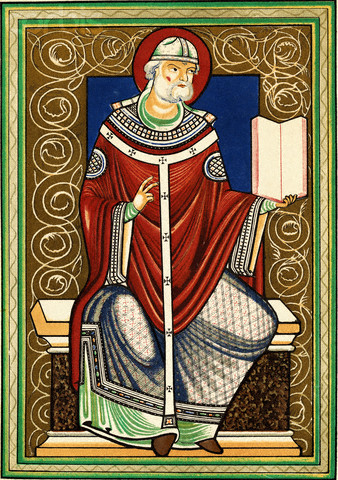
File:Pope Gregory I.jpg
Photo credit: Wikimedia Commons.


Father Greg was a good monk. So humble. He loved the peace and quiet of his monastery. It was so easy there to dismiss the distractions of the world and devote himself to prayer.

But then, Fr. Greg was chosen to be a bishop. That was then end of the serene contemplative life. He resisted the invitation at first, but finally submitted to the will of those who felt he was the only man for this particular job.

Dealing with his new diocese was really tough for Father Greg. He said he felt “divided and torn to pieces” by all the competing demands on his time and energy. Administrative tasks were the worst: the diocese owned lots of property. All sorts of projects and people needed money, and some were so manipulative in their attempts to get a piece of the pie that the bishop secretly thought of them as “robbers”. It was hard to be patient and charitable with these people. There were both physical and spiritual dangers of all kinds for the Bishop’s flock. Heretical ideas were gaining traction among the people. Criminal gangs were a huge problem in the city, and the bishop spent hours working with government officials to minimize the damage and devastation caused by them.

Bishop Greg (we had  better call him that now) worried about losing sight of his apostolic commission to preach the gospel, so much did all these chores distract him. His position forced him to spend lots of time with men of the world: politicians, the wealthy. He had to drop the introspective, retiring persona of a monk, and , well, “do as the Romans do.” Not wanting to appear judgmental or uncharitable, Bishop Greg talked with them about what they were interested in: sports, entertainment, the business world: “I began to talk freely about things I once would have avoided. What once I found tedious I now enjoy.” He felt bad about that change in himself, remembering the kind of spiritual life he had in the monastery.

Ever a humble man, the bishop admitted all this in a sermon. He said he often felt like a hypocrite, and a failure, not living up to his own preaching and mission. His congregation was bewildered, since as far as they were concerned, their bishop was a saint.

And now…the rest of the story.

Bishop Greg was a saint.

St. Gregory the Great. He became pope–bishop of Rome– under protest in the year 590. The description of his troubles above was taken directly from a sermon of his. It can be found in the Office of Readings as part of the liturgy that commemorates his feast day, September 3rd.

The only liberty taken in telling this story (besides the informal “Greg” and neglecting to mention that his diocese was Rome) was to refer to “street gangs” rather than “roving bands of barbarians”. This was the dark ages, when Rome was little more than one big refugee camp due to years of political strife and invasion. While dealing with all these problems, St. Gregory managed to blow off a heresy or two, reform the western liturgy, and revitalize the Church’s slumping missionary efforts.

But what I most admire about Father Greg—I mean, St. Gregory—was his humility in admitting how difficult it is to pursue holiness while living an active vocation. “Torn to pieces” by competing demands, he said. This makes him a sympathetic patron, not only of popes and bishops, but of all of us who long for a spiritual life but are sidetracked by many, many obligations.


This story appears in an upcoming book by Daria. She retains all copyrights to it. You can read more of her writing at  Coffee and Canticles.