Our Members' Blogs

Showing posts with label Liturgy of the Hours. Show all posts

Tuesday, September 10, 2013

Beloved

By Cynthia Scodova


Let the heavens rejoice, let the earth be glad,
  let the sea and its fullness resound.
The fields will rejoice, and all that is in them,
  all the trees of the woods will rejoice
  at the Lord’s presence – for he comes...
                                                                                     Psalm 96


                                  You are beautiful, my beloved,
                                  easing into
                                  the long bed of night;
                                  deep-indigo, star-dust satin
                                  you brighten
                                  each morning.

                                  Your light becoming
                                  what it touches:
                                  peridot pastures torching
                                  the uncontainable lines of heaven and earth;

                                  the fire rings of maples
                                  opening fists of rubies,
                                  citrines and sapphires,
                                  hues on hues of garnets
                                  scattering like broken necklaces
                                  across the blue-silver
                                  floors of the autumn air--
                                          our hearts seasons and solstices.


Continue reading Cynthia' poem at  The Mad-Eyed Monk.

Monday, August 26, 2013

God, come to my assistance

By Terry


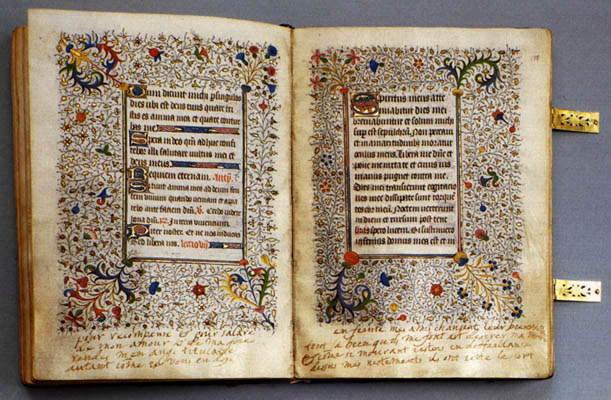
File:15th-century painters - Folio of a Breviary - WGA15805.jpg
Folio of a Breviary, 15th Century (photo credit: Wikimedia Commons).


God, come to my assistance.
Lord, make haste to help me.


These words are prayed at the beginning of the Liturgy of the Hours.  Simple.  Direct.  Practical.  I love this prayer.

Devotionals have their place.  The Rosary is beautiful and necessary.

But sometimes, all we need is something easy to remember.  You know the times I mean – the moments in life when you feel overwhelmed, when you’re struggling with family, finances, illness, the list goes on and everyone’s list is different.

For the past four years, I have participated in a 200 km walking pilgrimage to a shrine dedicated to the Canadian Martyrs.  It takes seven days to get to our destination.  The days are long and hot, the roads go on for what seems like forever.  Some of us jokingly utter that short, little prayer but we aren’t joking, not really.  Walking that distance is hard work; we get exhausted, blisters form, ankles get twisted, people faint in the heat of the day.  We can’t make it without an abundance of grace and divine intervention.


Continue reading at Terry's blog 8 Kids And A Business.

Thursday, August 22, 2013

Spiritual practices: Night Prayer

by Ruth Ann Pilney


Leaf from a Noted Breviary, ca. 1420 (photo credit: J.P. Getty Museum).


For the Christian who centers his or her day on God, the last act before sleeping is Night Prayer. When we were children our parents called it Bedtime Prayer.  
 
Through Night Prayer we dedicate the time we normally sleep to God. Also, we remind ourselves that one day we will die and rise, just as Jesus did. We entrust this time of unconsciousness to Him. As Psalm 15 says, "I will bless the Lord who gives me counsel, who even at night directs my heart." Many holy men and women have learned God's Will at night through dreams and visions.  St. Joseph, for example, was assured that it would be okay for him to take Mary as his wife.  He also learned that he should leave Bethlehem and flee to Egypt with Mary and Jesus.


Examination of Conscience

 
Part of Night Prayer is a brief examination of conscience, a silent time for reviewing the day.  This is to recall the times one did not live up to God's commandments, God's standards for good Christian conduct. As penitents we consider our faults and failings so as to make amends.  We express our sorrow to God and ask for His mercy and forgiveness.  I posted one version of an examination of conscience here.  There are other ways of doing it.


Scripture Readings from Liturgy of the Hours

 
The main feature of all the hours of the Liturgy are the psalms.  This is true of Night Prayer as well. Besides the psalms there is a weekly cycle of seven short Scripture readings for Night Prayer that consist of just a few verses.  
I am presenting them here, because, for those who don't do the Liturgy of the Hours, these are well worth reading and meditating upon before going to sleep.
 
 
Continue reading at Ruth Ann's blog From the Pulpit of My Life.

Friday, August 9, 2013

Speaking with God

by Barbara A. Schoeneberger


File:InfantSamuel.jpg
The Infant Samuel by Reynolds (photo credit: Wikimedia Commons).


The spiritual idiolect, that is, our own unique ways of speaking with God, was a new concept for me when I found it at this blog. It often takes me awhile to make something new my own before I can express myself adequately, and so it has been with this spiritual idiolect concept.

I never really thought before about how I communicate with God. I just did it. But now, reviewing a life nearing the seventh decade mark, I can see a progression of expression gathered from exposure to many kinds of Christian prayer.

When we were children, my brothers and sisters and I all learned the formal prayers of the Our Father, Hail Mary, Glory be, the Apostles Creed and the numerous beautiful ejaculations such as "My Jesus, Mercy," "O Sacrament most holy, O Sacrament divine, all praise and all thanksgiving be every moment Thine" and the like. Every night we prayed on our knees by our bedside, "Now I lay me down to sleep, I pray the Lord my soul to keep. If I should die before I wake, I pray the Lord my soul to take." There was also the beautiful "Angel of God my Guardian dear, to whom God's love commits me here, ever this day be at my side to light, to guard, to rule, and guide." Great theology is contained in these prayers that became more meaningful as I deepened my relationship with God. Still today I pray them all, each one becoming a little love song or chant that only God hears.

Speaking to God from the heart


There was another way we were taught by the good sisters when we were young, and that was to talk to Jesus as a friend and a helper, especially at Holy Communion. To approach Jesus in our own words and to thank Him for coming to us and for all He has given us, to tell him our problems and to ask His help made us experience Jesus as a real Person. I still keep that simplicity of approach today when every time I enter the pew for Mass, every time I make a holy hour, the first thing I say to the Lord is, "Thank you for being here, Lord, and thank you for letting me be here. Please bless the priest and all the people at Mass today." If it's a holy hour I just stop with the first sentence and use the old A Meditation Before the Blessed Sacrament as a guide.

This informality is comfortable and puts me in the mind of a child, an attitude of trust and confidence in God's love. Many times I use it about every day things, thanking God for His help with the garden for instance, telling Him what I'd like to have happen with it, etc. When we are in ferocious storm conditions I may say something like, "Lord, protect our house and property. Well, actually, it's Your house and Your property on loan to us. Please send your angels to guard us. But if it's Your will that we be sucked up in a tornado, that's OK, too." Then I pick up my rosary and start praying, or if it's getting late at night, I just say, "Lord, I'm too tired to stay up, so I'm not going to worry about the storm. Please take care of us." Then I sleep peacefully and thank God for watching over us the next day when I wake up.

Praying with Scripture and with the Church


I use this approach when praying for others and the poor souls, or when thankfulness bursts into praise. Sometimes, though, Bible verses run through my head and I use them for a continuous prayer of praise and glory. "To the King of ages, who is immortal, invisible, the one only God, be honor and glory forever and ever, Amen" from 1 Tim. 1:17 is a favorite that I chant silently when I feel called to do so. Since the Holy Spirit gave us the Bible I figure the Lord is really pleased to have us use His words to praise Him, thank Him, petition Him, etc. It's like a great composer hearing his own composition played in his honor.

Being a Benedictine oblate, the sacred liturgy forms a major part of my way of speaking to God because, in addition to hospitality, the Benedictines are all about the official prayer of the Church, the work of the people. Every time I attend Mass or pray the Divine Office I see myself as a tiny dot in a sea of people before the throne of God. Because the sacred liturgy belongs to the Mystical Body, it's not mine to tamper with or to shrug off lightly. Keeping these thoughts in mind helps me do my best when talking to God in the words and gestures of the Church.

Then there is Lectio Divina and meditation, both of which start out in a structured pattern but end up in an informal dialogue. Reflections from the great Carmelite saints always help make my meditation fruitful as do those from the great Fathers and Doctors of the Church.

In those times when I don't feel like praying or even have an aversion to it, I rely on an informal prayer that goes something like this, "Lord, I don't feel like praying today. The thought of it repulses me. What a chore. I don't even know what I do want to do instead of praying. But I'm going to pray anyway with Your grace. Let every act of doing my duty today be praise to You for giving me life, for sending me hardships, worries, and trials as well as all the good things You've blessed me with. I owe You, Lord. Please keep reminding me so that I grow in love of You. Help me to do Your will always."

Nothing fancy here. Just plain and simple, structured and unstructured, Benedictine, Carmelite, and Patristic, individual and community, words and no words. The roots of my spiritual idiolect were set down in early childhood and have fruited in old age from some very knobby branches. The plant looks a little puny in some places, but the Master Gardner continues to snip here and there with His great pruning shears. What else can be said but, "Thanks be to God"?


Barbara blogs at  Suffering With Joy.


Monday, August 5, 2013

Veils off! Veils on! And other random delight in the Transfiguration

by Daria Sockey 


File:Transfigurationbloch.jpg
Transfiguration by Bloch (photo credit:Wikimedia Commons).
 

Part of this title seems like  a shameless ploy to get page view traffic, drawing in readers who are interested in the question of wearing mantillas at mass. Or the even hotter controversy in this wide world over the hijab. But what I'm actually thinking of is the liturgical readings  for tomorrow's feast of the Transfiguration-- one of my very favorite feasts.

In the first reading of the Office of Readings(2 Corinthians 3:7-4:6)--a very appropriate reading, since it speaks of  Moses, a supporting player in today's feast--St. Paul plays on the metaphor of the veil. The Veil that hid the reflected glory of God on the face of Moses, the veil  of misunderstanding that keeps the Jews from seeing Scripture fulfilled in Christ, and the veil that the "god of this present age" puts between unbelievers and the truth. And finally, the joy of that veil's removal, so that we may now see "the glory of God shining on the face of Jesus Christ.

The second reading, from the fairly obscure Anastasius of Sinai, has answered a question that I had for years. You know when Jesus said in Matt 16:28, "Truly I say to you, there are some standing here who will not taste death before they see the Son of man coming in his kingdom" ?  I always wondered what He meant there. After all, the apostles died before the second coming.  I supposed that Jesus must have been referring to St. John, who certainly saw the triumphant Kingdom in his visions on Patmos. I never noticed what Anastasius noticed: that this prediction is followed up in the very next sentence  with its fulfillment: six days later, Jesus took with him Peter, James, and John...  the Transfiguration  the event in which three apostles saw the glory of the kingdom before they tasted death!

Of course, Anastasius was not hindered by the chapter divisions in the gospels that tend to keep  us from connecting these types of dots.

Okay. Here's one more thing I always think about and laugh about (it's a feast day--we should find things to laugh about!).  How did the apostles recognize Moses and Elijah? We're told that the Jews eschewed most  representational art out of concern for avoiding the temptation to idol worship. So how did they know who was speaking with Jesus on Mt. Tabor? Was Moses carrying his signature tablets of the law? Did Elijah arrive in his chariot, or perhaps have that helpful raven on his shoulder? The gospels don't tell us. Inquiring minds want to know!

There is so much in the Transfiguration account: the voice of the Father, the sweet and gentle, “rise and do not be afraid” from Jesus, and the interesting connection between Elijah and John the Baptist. It's no wonder the Church has us mark this event twice a year-once on a Sunday in Lent and once as a feast.

Pay attention at Evening Prayer (vespers) today. The New Testament canticle is one we only get today and on the feast of the Epiphany.  It's an adaptation of 1 Timothy, 3:16, with a repeated response worked in. For those of you who don't pray the Liturgy of the Hours, here it is:

Praise the Lord, all you nations.
Christ manifested in the flesh,
Christ justified in the Spirit.

Christ contemplated by the angels,
Christ, proclaimed to the pagans.

Christ who is believed in the world,
Christ exalted in glory. Praise the Lord, all you nations.

Knowing that this passage is only used for these two feasts out of the entire year makes for a great little meditation on  how those two are connected.

Daria blogs at   Coffee and Canticles.

Friday, August 2, 2013

Is the Lord your King?

by Heidi


public domain via wikipedia
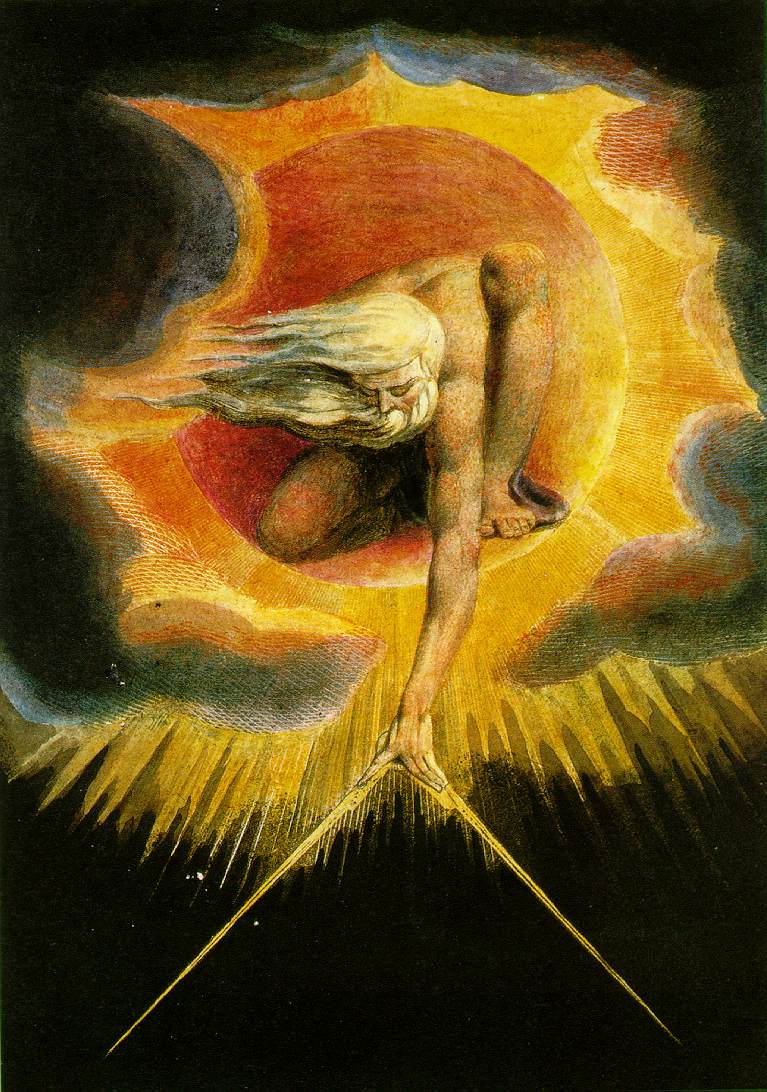
Ancient of Days by William Blake (photo credit:Wikipedia).


What does it take to awaken awe and wonder of the Lord? What keeps you from running to all the petty little idols surrounding us that promise so much, but rob you of your eternal inheritance?

The Lord is king, let the earth rejoice, let all the coastlands be glad. Cloud and darkness are his raiment; his throne, justice and right. A fire prepares his path; it burns up his foes on every side. His lightnings light up the world, the earth trembles at the sight. The mountains melt like wax before the Lord of all the earth. The skies proclaim his justice; all peoples see his glory. Let those who serve idols be ashamed, those who boast of their worthless gods. All you spirits worship him. Psalm 97:1-7

According to my Divine Office app this psalm foretells worldwide salvation and that all nations will believe in Christ. One of the things that I love about praying the Divine Office is how it helps to stir up awe. Even when my personal prayer is dry, the Psalms that are prayed in the Office always lift up my heart with wonder, if even for just a moment.  I cannot ponder them enough.

As our contemporary culture continues to embrace materialistic philosophical views of the world, I love being reminded, “the earth rejoices and the coastlands are glad.” I love how the phrase: ‘cloud and darkness are his raiment ‘increases my wonder for the mystery that is Our Lord. It both establishes God’s absolute authority over all, and reveals how the shabby materialistic philosophies are blind to the great transcendent dignity of man.

To reduce our humanity to biological chance goes against everything that we are naturally oriented to.  The ancients pagans were much wiser than we are in our present technologically advanced age when they saw divinity in the sun, the moon and the stars.  They may have missed the mark in their worship, but our lot in life with everything around us reduced to only what can be quantified and measured is so much more demeaning to our true nature.  We are no less blood thirsty than those who sacrificed humans on altars to false gods --  we sacrifice our children in abortion for petty comforts.


Continue reading at Heidi's blog  Journey to Wisdom.

Tuesday, June 11, 2013

How to complain to God in 3 easy steps

by Daria Sockey


File:Stuartbreviary.jpg
Mary Stuart's Breviary (Photo: Wikipedia)


I used to think it was wrong to complain to God. I had overdosed on those stories where saints are portrayed as  positively craving new opportunities to suffer for the love of God-- bursting into rhapsodies of delight at each new illness, inconvenience, and disappointment. And so, when the thought would cross my mind in times of trouble—God, what on earth were you thinking to let this happen to me?—I thought I was being at least slightly sinful.

But King David and the other psalmists complain plenty. They go on in great detail about how bad life is at the moment, and ask God why He hasn't fixed it yet. They tell God they don't understand why He worked so many miracles in the past but doesn't seem to do so anymore. They point out that non-believers are suggesting that maybe God is not so great if He allows  such  disasters to happen to His friends. 

We can't dismiss this by saying, "That was the Old Testament."  After all, the psalms were the prayers that Jesus used. As He was dying, he cried to His Father with the ultimate complaint from Psalm 22, “My God, my God, why have your forsaken me?”

Psalm 42 shows us the way


Yesterday's Morning Prayer from the Divine Office (Psalter, Monday Week II) starts with a wonderful example of the biblical way to complain--Psalm 42. It opens with sheer poetry, expressing our deepest longing:"Like a deer that years for running streams, so my soul is thirsting for you, my God..."

But soon the psalmist makes it clear that he is pretty miserable: "My tears have become my bread by night and by day, as I hear it said all the day long,'Where is your God?'"

"I remember...how I would lead the rejoicing crowd into the house of God...the throng wild with joy."

Now, check this out: "Why are you cast down, my soul, why groan within me? Hope in God, I will praise Him still, my savior and my God." A complete acceptance of suffering? Not quite. After this expression of trust, he is immediately back to complaining. "Why have you forgotten me? Why do I go mourning, oppressed by the foe?...my enemies revile me, saying to me all the day long, 'Where is your God?'"

Despite that, the psalm ends with the refrain, "Hope in God, I will praise him still, my savior and my God."

Complaining and trust aren't mutually exclusive


The pattern is easy to see. Complain while trusting. Trust while complaining.

This makes perfect sense. In fact, it is what good (albeit fallen) children will do. Think of that fussy toddler screaming his head off while clinging to Mom's leg.  The whiny six year old whose favorite phrase is “That's not fair.” Or the  teenager pouting in her room. Despite each age-appropriate version of “why have you rejected me?”  they know that you love them and have their best interests at heart. Not that they are likely to say, “That's okay, Mom. I trust you, even if you don't buy me an Ipad.” These are fallen children we're talking about. But their continued trust is, I think, implicit. Maybe this is part of what Our Lord meant when He said we should become like little children.

Of course, it would be better to follow up our complaints to God with explicitly stated trust in Him. And the psalms are excellent models of how to do this. Complain. Trust. Repeat.

Daria Sockey originally posted this at her blog  Coffee and Canticles.

Monday, May 27, 2013

Each Morning

by Cynthia Scodova


                                                                      My heart is ready, O God –
                                                                      my heart is ready.
                                                                      I shall sing and make music.
                                                                      Awake, my glory!
                                                                     Rise up, harp and lyre!
                                                                     We will awaken the dawn.
                                                                                           Psalm 107


File:El Rio de Luz (The River of Light) Frederic Edwin Church.jpg
The River of Light bu Frderic Edwin Church (Photo Credit: Wikimedia
Commons).


                                                                  What love
                                                                   Each morning

                                                                   Diffuses our darkness
                                                                   Brightens the yards of our sleep

                                                                   Making rose-gold fire
                                                                   Spill into the branches of trees

                                                                   The soft flesh of the hills
                                                                   Burning

                                                                   The worn crusts of our hearts
                                                                    Into a glance of you

                                                                  Wherever I look
                                                                  Whomever I see

                                                                   Something of you Lord.


Find more of Cynthia's poetic reflections on the Liturgy of the Hours at  The Mad-Eyed Monk