Our Members' Blogs

Showing posts with label Ruth Ann. Show all posts

Saturday, November 2, 2013

Meditate on the Last Things

By Ruth Ann Pilney


File:John Everett Millais - Autumn Leaves.jpeg
Autumn Leaves by Millais (photo credit: Wikimedia Commons).


Watching the beautiful autumn leaves fall reminds me of the temporality of earthly life. An excerpt from Bambi, a children’s novel by Felix Salten, is a dialogue between two oak leaves clinging to a branch high above the others.
     “So many of us have fallen off tonight we’re almost the only ones left on our branch,” said one. 
     “You never know who’s going to go next,” said the other.
     “Can it be true,” said the first leaf, “can it really be true, that others come to take our places when we’re gone and after them still others, and more and more?”
     “It really is true,” whispered the second leaf.  “We can’t even begin to imagine it. It’s beyond our powers.”
     After a period of silence, the first leaf said quietly to herself, “Why must we fall?”
     The second leaf asked, “What happens to us when we have fallen?  Do we feel anything, do we know about ourselves down there?”
     “Who knows?  Not one of all those down there has ever come back to tell us about it.”
     “Let’s not talk any more about such things,” said the first leaf.
     “No, we’ll let it be.”
Many people eschew discussing death, but at this time of year the Church encourages us to ponder such things: death and judgment, heaven and @#!*% , the end of the world, the second coming of our Lord and Savior, and the establishment of the Reign of God.  We wait in joyful hope!


Ruth Ann originally posted this at her blog From the Pulpit of My Life.

Thursday, September 19, 2013

Spiritual practices: repentance

By Ruth Ann Pilney


File:Guillaume Bodinier - Paysanne de Frascati au confessionnal,.jpg
Native of Frascati at the Confessional by Bodnier (photo credit: Wikimedia Commons).


Repentance refers to sincere contrition for wrongdoing or sin, and it involves promising to change for the better. Regularly repenting is a good spiritual practice. This can be done daily, especially in the evening at day's end before going to bed.

St. John Chrysostom, an early Church Father, Doctor of the Church,  and dynamic preacher of the 5th century, delineated five paths of repentance. They are "condemnation of your own sins, forgiveness of our neighbor's sins against us, prayer, almsgiving and humility." He elaborates on each of these.


Condemnation of your own sins

"Be the first to admit your sins and you will be justified. For this reason, too, the prophet wrote: I said: I will accuse myself of my sins to the Lord, and you forgave the wickedness of my heart. Therefore, you too should condemn your own sins; that will be enough reason for the Lord to forgive you, for a man who condemns his own sins is slower to commit them again. Rouse your conscience to accuse you within your own house, lest it become your accuser before the judgment seat of the Lord."
While living here on earth we can examine our conscience and notice when we have failed to live up to our baptismal promises, whether in large matters or lesser ones.  The important thing is to slowly weed out our sinful tendencies and to replace them with virtue.  For example, the sin of arrogance can be replaced with compassion and mercy.


Continue reading at Ruth Ann's blog From the Pulpit of My Life.

Thursday, August 22, 2013

Spiritual practices: Night Prayer

by Ruth Ann Pilney


Leaf from a Noted Breviary, ca. 1420 (photo credit: J.P. Getty Museum).


For the Christian who centers his or her day on God, the last act before sleeping is Night Prayer. When we were children our parents called it Bedtime Prayer.  
 
Through Night Prayer we dedicate the time we normally sleep to God. Also, we remind ourselves that one day we will die and rise, just as Jesus did. We entrust this time of unconsciousness to Him. As Psalm 15 says, "I will bless the Lord who gives me counsel, who even at night directs my heart." Many holy men and women have learned God's Will at night through dreams and visions.  St. Joseph, for example, was assured that it would be okay for him to take Mary as his wife.  He also learned that he should leave Bethlehem and flee to Egypt with Mary and Jesus.


Examination of Conscience

 
Part of Night Prayer is a brief examination of conscience, a silent time for reviewing the day.  This is to recall the times one did not live up to God's commandments, God's standards for good Christian conduct. As penitents we consider our faults and failings so as to make amends.  We express our sorrow to God and ask for His mercy and forgiveness.  I posted one version of an examination of conscience here.  There are other ways of doing it.


Scripture Readings from Liturgy of the Hours

 
The main feature of all the hours of the Liturgy are the psalms.  This is true of Night Prayer as well. Besides the psalms there is a weekly cycle of seven short Scripture readings for Night Prayer that consist of just a few verses.  
I am presenting them here, because, for those who don't do the Liturgy of the Hours, these are well worth reading and meditating upon before going to sleep.
 
 
Continue reading at Ruth Ann's blog From the Pulpit of My Life.

Tuesday, July 23, 2013

Spiritual practices: going on retreat

by Ruth Ann Pilney


File:Carava13.jpg
Martha and Mary Magdalen  by Caravaggio (photo credit:Wikimedia Commons).
 
 
In Sunday's Gospel, the story of sisters Martha and Mary who welcomed Jesus into their home, we heard the Lord saying,
Martha, Martha, you are anxious and worried about many things.  There is need of only one thing. Mary has chosen the better part and it will not be taken from her.
This narrative of the two sisters highlights the value of spending time away from the hustle and bustle of everyday living to focus intently on simply being with God in prayer and contemplation.
If we look towards Jesus, we see that prior to any important decision or event he recollected himself in intense and prolonged prayer. Let us cultivate the contemplative dimension, even amid the whirlwind of more urgent and pressing duties. .... Herein lies the secret of the fruitfulness of a disciple of the Lord!  ~ Holy Father, Pope Francis
Sometimes it is good for one's soul to withdraw from the turbulence of everyday life and spend an extended period of time in prayer and reflection at a secluded and quiet location.   I have recently returned from a 6-day silent, directed retreat.  This is something I do regularly to keep myself grounded in my commitment to walk with Christ.


Continue reading at Ruth Ann's blog  From the Pulpit of My Life.

Monday, June 24, 2013

Receiving Communion well

by Ruth Ann Pilney
  

As a Catholic I believe what the Church teaches about the Holy Eucharist; that is, when consecrated by the priest at Mass, ordinary bread and wine are changed, through the use of the words that Christ spoke at the Last Supper and by the power of the Holy Spirit, into the body and blood, soul and divinity, of Jesus.  Catholics who understand this great and miraculous sacramental mystery revere and worship the Lord in his Real Presence.

When a Catholic participates at Mass, the Church encourages those who are well-disposed to receive Holy Communion. Only those who are Catholic, in the state of grace, and have observed the required fast may receive Communion.  It is also expected that the recipient will approach the sacrament prayerfully and show signs of respect in posture and dress.

The following video shows the right protocol for receiving Holy Communion.  If you are Catholic, I would encourage you to watch this short video, which is presented with both seriousness and humor.


Read Ruth Ann's suggestions for the silent period after Communion as this post continues at  From the Pulpit of My Life.

Wednesday, May 29, 2013

Spiritual practices: examination of conscience

by Ruth Ann Pilney


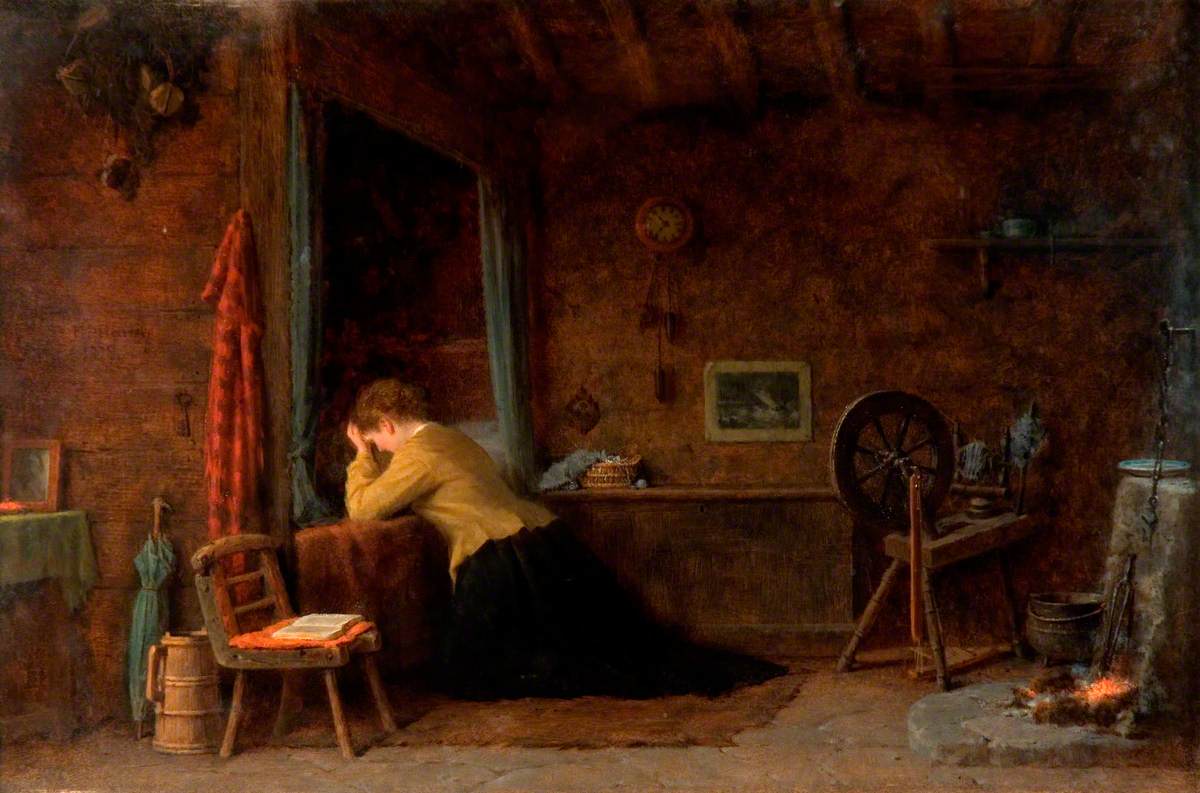
File:A Prayer for those at Sea by Frederick Daniel Hardy.jpg
Painting by Frederick D. Hardy (Photo Credit:Wikimedia).


As a Christian I am bound to follow my conscience, my inner guide to doing good and to avoiding evil.    Every evening, as the day winds down, I spend about ten minutes at the beginning of Night Prayer to review my day by examining my conscience.  The guide that I have found most helpful lately is called "An Examen."

I like this way of reflecting on my day because it is balanced.  It helps me see both the times I practiced virtue as well as the times I sinned.  This is in contrast to other examinations I have used which emphasize only the sinful acts.  Noticing God's goodness and appreciating His providence is another outcome that has helped me.  I feel a strong impulse to give God glory and praise as a result.

First I remember that I am in God's presence.
Heavenly Father, I know you are with me, looking at me with love and caring for my every need.  

Then I review my day and express gratitude.
Loving Father, thank you for this day.  Thank you for the gifts and graces you have given me.  Thank you for life itself.  Thank you for the people who have graced me and touched me.

Between sentences I pause and recall something for which I am specifically grateful about the day, the graces, the people that God has placed on my path.  Today, for example, I was grateful for the gift of understanding a section of a piece of guitar music that has been a challenge to learn.  I also thanked God for my unexpectedly meeting a friend and her son at the frozen yogurt store.


Read the rest at Ruth Ann's blog  From the Pulpit of My Life

Wednesday, May 8, 2013

Crepusculous Moments

by Ruth Ann

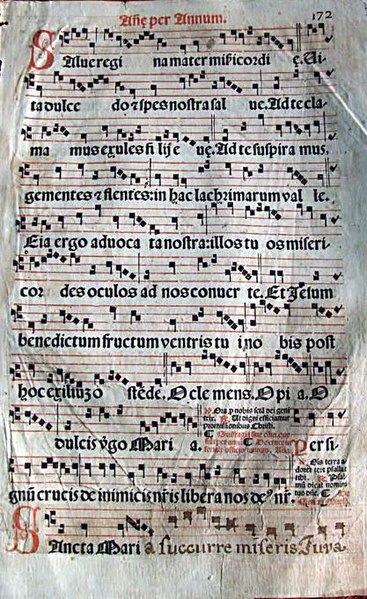
File:Antifonario (Salve Regina).jpg
Manuscript of Salve Regina (Photo Credit: Fedkuki, Wikimedia).


 I have discovered a particularly unique time of the day, a space when time itself seems to stand still. Sun has just set, yet there is still the soft glow of scattered light from the refraction of the sun's rays. One hears the sound of utter silence. There are no bird twitters. They have roosted. No animals are walking about; nor are they making sounds. Nocturnal wildlife has not yet stirred. Within this hush peace emerges. I know God's presence. I pray, giving praise and thanks.

The twilight time ends with the first cricket's chirp, soon followed by others. Twilight gives way to nightfall. I feel like singing Salve Regina.


Originally posted by Ruth Ann on her blog  From the Pulpit of My Life. Please visit Ruth Ann for more reflections from a Third Order Carmelite.