by Connie Rossini
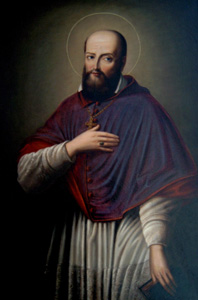 |
| St. Francis de Sales (photo credit: Wikimedia Commons). |
CSBN
has been running a series on
spiritual idiolects, a phrase I coined to
mean the unique way each person relates to God. I hope that you will
find "kindred spirits" in these posts, and be drawn to follow bloggers
who have a similar spirituality to yours--or those whose are
surprisingly different.
My spiritual idiolect is practical
mysticism. I've always hated the saying, "He's so heavenly minded that
he's no earthly good." The truly heavenly minded do the most earthly
good. Think of St. Therese, who even wanted to do earthly good while in
Heaven. She reached the heights of the prayer life, and actively loved
her neighbors. That's what I aspire to. I want to be a contemplative
wife and mother. I want to love God and my neighbor.
I loved St. Therese from the first time I read about her as a child. Her personality appealed to the romantic idealist in me.
Later, my older sister urged me to read
Introduction to the Devout Life
by St. Francis de Sales. Now, there's a great book! St. Francis taught
lay people how they could be saints, giving them tips on every area of
life. How do you know when temptation becomes sin? How can you practice
Christian meditation? How can a lay person live in the world and be
properly detached from it? St. Francis answers all these questions. I
need concrete direction. That's why I love St. Francis.
The next saintly influence on my spiritual idiolect came from Teresa of Avila. Although I didn't really understand
The Interior Castle
the first time I read it, it drew me to a life of prayer. Eventually, I
joined the Secular Order of Discalced Carmelites. They explained St.
Teresa's teaching to me. They also introduced me to St. John of the
Cross.
Today I am no longer OCDS, but I am thoroughly
Carmelite in my spirituality. St. John in particular taught that
mysticism is not a matter of visions, locutions, and altered states.
Rather, it is a matter of a deep communion with God in prayer. Aspiring
to be mystics as the world sees mysticism can be dangerous. Aspiring to
grow in prayer is the call of every Christian.
Now I
try to give practical spiritual help to others through my blog and
ebooks. (I'm working on a full-length one right now to add to my short
ebook published in June.) I like to teach people, including children,
about the differences between true and false mysticism, Christian and
eastern meditation, and Christian and pagan asceticism and detachment. I
am striving to be holy in the little things of every day life. I am
working to be heavenly minded and earthly good.
Connie Rossini is the administrator of Catholic Spirituality Blogs Network. Her personal blog is Contemplative Homeschool.