Our Members' Blogs

Showing posts with label Writing. Show all posts

Sunday, September 1, 2013

Blog titles that say "Click on me."

By Connie Rossini


File:1895 TreasureIsland RobertsBros tp.png
Choose your title for maximum readership. Photo credit: Wikimedia Commons.

 
 This post is part of our monthly series, Catholic Bloggers' School.
 

 Avoid flowery language

Members of CSBN know that I sometimes change the titles of their posts on our site. Partly from reading posts about blogging, partly from watching the stats on this blog, I have learned a lot about the types of titles that draw readers in. A good title will bring readers from Pinterest, Google+, Facebook, and Twitter. It will make your subscribers open their email sooner.


Titles that work well for creative writing don't often work for blogs. For example, I'd love to write a post called Blogging in Borrioboola-Gha. If you're not a fan of Charles Dickens, that title would likely puzzle you. Some people might click on it just out of curiosity. But how many people would search for "Borrioboola-Gha"? A better title on the same subject might be Family Before Blog. That's not as creative or interesting, but it conveys to a wider audience what the post is about. And someone might even Google it.

You don't want to bring just any traffic to your site. You want to bring people who are actually interested in what you have to say. Make it easy for them to find you.

Ask a question

Do you know your ruling grace? Are you a jackass for Christ? Can you love God for just one minute? These are three of our recent posts at CSBN.

 When your title is a question, readers want to discover the answer. Make sure you give it to them, or give them the tools to find out for themselves!

How to ...

Starting your title with "How to" lets readers know they will learn something from your writing. If you are running out of ideas for your blog, brainstorm a list of how-to posts. You could get a lot of hits from searches this way.

Numbered lists

If your post is about saints who are known for answering prayers, title it 5 Saints Who Never Fail You. If you're making suggestions for All Saints' Day dinner, call it 3 Delicious Recipes for All Saints' Day. I have done posts beginning with 4 tips, 3 ways, and 5 reasons. These titles are easy to remember if readers want to return to your blog in the future. Your tips are also easier to remember in a list.

Titles are not the most important part of your blog post, but without a good title few may click on it. It doesn't matter how good your post is if no one reads it.


Tuesday, August 6, 2013

Power in simplicity

by Rebecca Duncan


File:William-Adolphe Bouguereau (1825-1905) - Inspiration (1898).jpg
Inspiration by Bouguereau (photo credit: Wikimedia Commons).


Catholic Spirituality Blogs Network has been running a series about the Spiritual Idiolect.  The Spiritual Idiolect is the unique way that each of us interacts or speaks with God.  

One thing I've noticed in the way I talk to God is that when I'm closer to Him I tend to say less.

If I go back through my prayer journal, I can usually tell simply by how long that day's entry is whether I was recollected that day or not.  If I'm not recollected the entries tend to be long, chaotic, restless and focused on myself and whatever problems I'm having.  If I'm recollected, the entries are short, to the point, peaceful, and focused on God even amidst difficulties. 

It's the same when I'm not writing.  If I'm recollected, I don't want to hear from myself.  I need to be silent before the Lord.  If I'm not recollected, I tend to spend a lot of time talking to Him about my problems and indulging in self-pity.

When I was converted, God gave me a very specific knowledge of who He is.  He is love, and He wants to consume me with His love.  That was my introduction to the Lord.  It was simple and yet so powerful.  When I allow Him to love me, I am consumed.  I decrease and He increases.  In those rare times, everything in my life becomes simple and powerful. 

Rebecca blogs at  Otaku Catholic.

Thursday, August 1, 2013

Catholic Bloggers' School: Great beginnings

by Connie Rossini


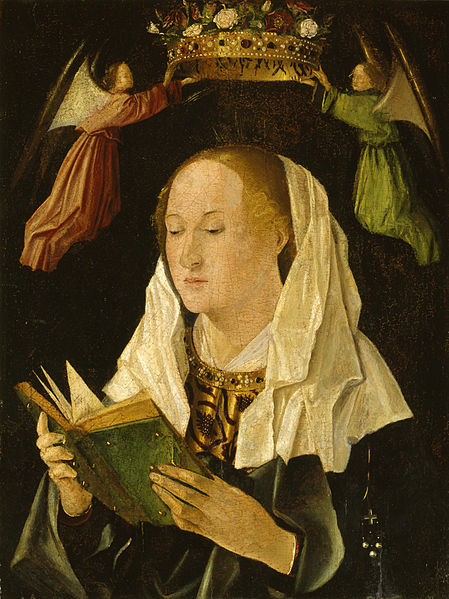
File:Antonello da Messina - The Virgin Mary Reading - Walters 37433.jpg
The Virgin Mary Reading by Antonello da Messina (Photo credit: Wikimedia Commons).


What's the difference between a post that never gets read and one that gets shared multiple times on social media? Often it's how the post begins.

Master novelists know how to hook their readers in from the first sentence. They start with humor, mystery, excitement, or an intriguing idea. Consider these story openers:

"It was the best of times. It was the worst of times..."  (A Tale of Two Cities  by Charles Dickens)

"It is a truth universally acknowledged that a single man in possession of a large fortune must be in want of a wife." (Pride and Prejudice by Jane Austen)

"In the last days of Narnia..." The Last Battle by C.S. Lewis)

Don't they make you want to read more?

Of course, a blog post isn't a novel. But since it's much shorter (like people's attention spans), it's even more important for bloggers to come to the point quickly. This is challenging in the blogosphere. Blogs got their start as online journals, and many bloggers like to share their daily lives with their readers. The temptation to ramble never goes away. Sometimes I want to share tidbits of my life with my audience that don't directly relate to my subject matter. I've decided the best place for those is FaceBook, rather than as slow introductions to my posts. Besides, that gives readers an added reason to "Friend" me.

Why do people read your blog? If you're a member of CSBN, chances are they want to grow in their faith. Let them know right away how your post will help them. You can do this in your title or in your first line. Or you can pose a question that used to plague you. It's probably plagued your readers too. If you're writing about a virtue or spiritual practice, tell a brief story of a saint who exemplified it.

Here are some first liners you can steal from me for future posts:


  • I realized today I know nothing about following God. Nothing.
  • Have you ever wondered why...?
  • Francis de Sales has always been one of my favorite saints.
  • The biggest surprise in my spiritual life happened when...
  • I just read a book that changed my life.
  • If I could live life over, I would be humble from the start.
  • Have you prayed the Rosary lately?

Besides keeping your readers on the page, great beginnings can bring new readers to your blog. Search engines analyze your title and first paragraph to determine what your post is about. If you want someone to be able to find your blog through key word searches, make your first paragraph meaningful.

Challenge: Create some great first lines that your fellow Catholic bloggers could really use. Share them in the comments box. Then try to use one or more in the next month.


Connie Rossini blogs at  Contemplative Homeschool.

Monday, June 3, 2013

Catholic Bloggers' School: tighter writing

by Connie Rossini


This post is the first in an intended series to help us improve our blogs for the glory of God. I hope to post an article once a month, with interviews, quotes, and guest posts from various experts in the future.

 "Content is king," says the cliche. You may have the world's greatest insights, but if your writing is difficult to read people will skip to the next blog. How many millions are there, after all?

A first step in improving your writing is making it tighter. That means saying the same thing in fewer words. Consider these two paragraphs:

1)    Many years ago, when I was first submitting articles to be published in our local diocesan newspaper, The Catholic Times, I realized I was using too many words. My natural tendency in writing about a subject was to use about 800 words, but my editor wanted to limit the column to 500-600 words. That meant I had to chop at least 200 words (25%) off my first draft. It was a challenge! However, I found that I could do it while improving my writing. I learned to make every word count. I got rid of unnecessary adjectives and adverbs, parenthetical phrases, and the like. After a few months of practice, I found it was much easier to write a shorter column from the start. I had formed the habit of tighter writing. My new "natural" column length was just right for the needs of my editor.

2)    When I first began writing columns for our diocesan newspaper, I found my natural tendency was to use 800 words. My editor wanted a column of 500-600 words. I had to chop 25% off my first draft. What a challenge! However, I found I could do it while improving my writing. I learned to make every word count. I excised unnecessary modifiers and parenthetical phrases. After a few months' practice, it was easier to write  a shorter column from the start. I had formed the habit of tighter writing. My new "natural" column length was perfect for my editor's needs.

I cut 45 words to go from version 1 to 2 without sacrificing clarity. The second paragraph may not be  brilliant, but it's concise and precise. Using fewer words requires stronger verbs and nouns, which are more poignant. It breathes confidence and expertise. Readers trust you not to waste their time.

Avoid these common phrases


Here are some commonly used phrases and more concise substitutes (some of these examples are taken from The Elements of Style by William Strunk, Jr. and E.B. White):

Every now and then - sometimes
Over and above - beyond
I thought to myself - I thought
as to whether - whether
owing/due to the fact that - since/because
end result - result
my personal opinion - my opinion
for all intents and purposes - (It's best to rewrite the sentence without this phrase)

Get rid of the words very, really and about. They weaken your writing. Choose stronger verbs that don't need a modifier. For example, leaped  is not only less wordy than jumped high - it also paints a more vivid picture.

Use active, not passive, voice. Instead of, It is believed by most people, write, Most people believe.  Avoid starting sentences with there is or there are.

Short blog posts can still be wordy, while long posts can be tightly written. Almost everyone uses needless words from time to time - er, sometimes. Don't focus on the number of words, but on the necessity of each word.

Try this: Write a new post and count your words. Try to reduce them by 10-20% without sacrificing clarity. Then share your post with us by linking to it in the comments below.


Connie Rossini is the administrator of Catholic Spirituality Blogs Network.  She blogs at  Contemplative Homeschool.