Our Members' Blogs

Showing posts with label Deacon Paul Rooney. Show all posts

Wednesday, November 6, 2013

Lucky underwear, or prayerful perseverance?

By Deacon Paul Rooney


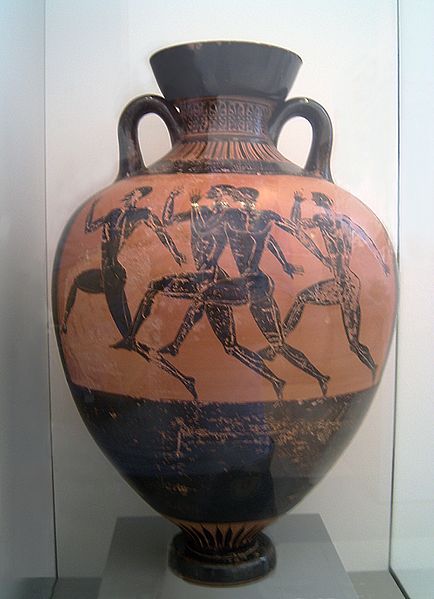
File:Altes Museum Berlin - Antikensammlung23 b.jpg
Greek Vase in the Altes Museum of Berlin (photo by
Marcus Cyron, Wikimedia).


I hope that none of you have superstitious notions.  According to a BBC poll just this year, it seems like one in three college kids think it worth giving "lucky underwear" a try, especially just before a college exam!

If you have ever watched "Track and Field" events in the Olympic games, back in the era of the famous Carl Lewis in the late 1980's, perhaps you may remember the name of an Olympic marathon "hopeful" by the name of Margaret Groos, a girl from Tennessee.  Before she eventually had to withdraw from competitive sports because of a hyperthyroid condition, someone asked her the reason for her early success.  Her answer made it into the "famous quotes" archives.  She said this:
"When I was 15, I had lucky underwear. When that failed, I had a lucky hairdo, then a lucky race number, even lucky race days.  After 15 [more] years, I’ve found the secret to success is simple.  It’s [just] hard work."
Perseverance in good actions is always the answer, isn't it?  God gave each one of us certain gifts and skills, and He wants us to use them.  God did NOT say, "Don't forget to go to work today without your Rabbit's foot."  NOR did he say, "Make sure you read your horoscope today, it will guide you."  And He certainly did NOT say, "Don't forget to wear your lucky underwear."  What he did say is found in the First Commandment.


Continue reading at  Journey to Wisdom.

Wednesday, October 23, 2013

Harsh words from Jesus

By Deacon Paul Rooney


Jesus has some harsh words in today's Gospel for those who do not tend to their spiritual journey.  One road on this spiritual journey speaks to me of love, and our invited response to the ethical demand of the gospel.  The other road speaks to me of hypocrisy.  Both roads reveal themselves eventually.

I can remember vividly the time when I was a paperboy for the Fremont Tribune many decades ago.Every late afternoon during the weekdays I would make my rounds delivering the Tribune.  Then on the first Saturday morning of the month, I would make the rounds collecting the monthly subscription price of 15¢. [How times change…the price today is $12.25 to have it delivered to your door by a paperboy!]

During the daily deliveries all month long, all I would see would be the outside of the homes: all very nicely painted, yards well-trimmed, and so on.  But once a month when I collected, they would invite me inside and I would see the absolute mess or chaos that the homes really looked like inside, away from the eyes of the world.  I suspect many of us can visualize that scene.  How many times have we received a surprise phone call from someone saying they would be arriving soon to visit - - so we hit the panic button and clean up the inside of the house (or at least that part that the Visitor will see)!

This is sort of what Jesus is getting at in today’s Gospel (Luke 11:37-41). Jesus seems to get a little tough with his host, calling him and all the Pharisees fools!! That’s probably not something you would expect an invited person to call you, right in your own home. But that really was in keeping with the rabbinic tradition, which could also be harsh with some Pharisees.  In that culture, it meant that the Pharisees were being seen by Jesus as being arrogant, which in turn means the Pharisees were acting out of self-important pride in their own ability to follow the ritual rulebook.  And their man-made rulebook said that everyone had to wash their hands and forearms before eating.


Continue reading at Journey to Wisdom.

Saturday, October 12, 2013

Beware of spirtual leprosy!

By Deacon Paul Rooney


File:CodexAureus Cleansing of the ten lepers.jpg
Cleansing of the 10 Lepers from Codex Aureus (photo credit: Wikimedia Commons).


There is a well-known yarn, one which may or may not be true, that you can find in the writings of a nephew of Mark Twain, writings about the famous author and Nobel Prize winner, Rudyard Kipling.  You remember the things Kipling wrote like "Gunga Din" and "The Jungle Book," both of which were made into movies. Kipling sold one of his books for a price that netted him one shilling for every word, which might be about 40¢ a word today.  So sure enough, one wise guy mailed him a shilling, asking him for one word.  Rudyard Kipling responded with one word: "Thanks."  Well, in today's gospel (Luke 17:11-19) Jesus gave ten lepers something far more significant than a shilling: he restored them to physical wholeness.  Yet only one man responded with that precious word, "Thanks."

Two things make this episode unusual. First, only one of the ten men returned to give thanks to Jesus for the healing. Since Jesus made a pointed comment about this, it highlights the direct connection between gratitude and faith. One precious gift, faith, should lead everyone to the proper response, gratitude.  An obvious message is that every Christian should be so grateful for the gift of faith-that-leads-to-salvation that they will praise God daily for so wondrous a gift.  We believe in God's promise of salvation, and we recognize that he died to save us.  When we stumble and fall through personal sin, the Sacrament of Reconciliation once again restores us to spiritual wholeness.  Grace upon grace, gift upon gift!  Praise and thanksgiving for God's tender mercies should well up in us throughout the day, every day!

The second unusual detail in this gospel segment is that it was not the nine Jewish men, but only the Samaritan who demonstrated his gratefulness for being made whole.  He returned, throwing himself at the feet of Jesus in thankfulness.  Jesus had every right to be sad, seeing that only one person saw fit to return and thank him for the healing, especially since the other nine men were fellow Judeans.  Jesus did not "need" their thanks; he had experienced rejection before.  But he knew that the insensitivity of the nine men gave a glimpse into the condition of their heart and mind.  They may have been cured of leprosy of the body, but they now had spiritual leprosy of the mind, a condition of ingratitude and ungratefulness.


Continue reading at  Journey to Wisdom.

Saturday, September 14, 2013

Within your wounds hide me

By Deacon Paul Rooney


File:Fra Angelico 073.jpg
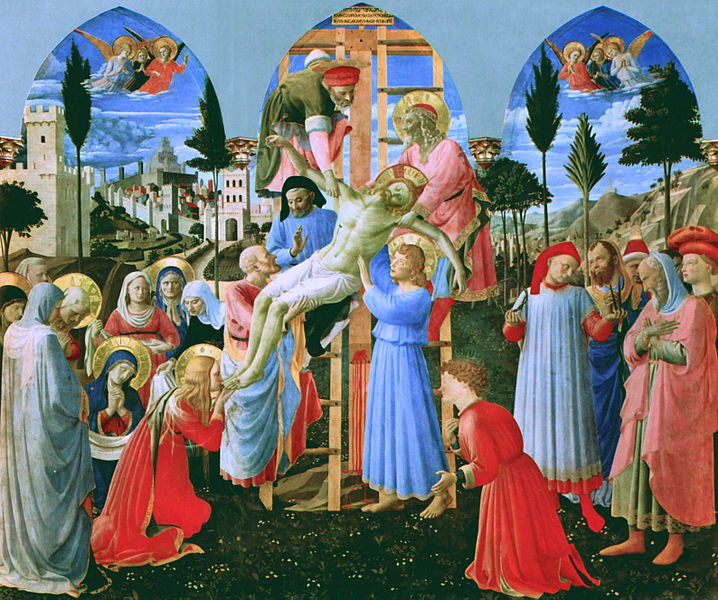
The Deposition  by Fra Angelico (photo credit: Wikipedia).


Everyone is familiar with the great contemplative prayer that we call the "Anima Christi" – "Soul of Christ." These are the opening words of a famous prayer from the 14th century; the author's name is uncertain (but the prayer is sometimes attributed to St. Ignatius of Loyola since it is included in his Spiritual Exercises). Many of us pray this beautiful prayer immediately after receiving the body and blood of Christ at Mass every day.  Here is the prayer (taken from my copy of the Spiritual Exercises, Ganss translation): 

Soul of Christ, sanctify me.
Body of Christ, save me.
Blood of Christ, inebriate me.
Water from the side of Christ, wash me.
Passion of Christ, strengthen me.
O Good Jesus, hear me.
Within your wounds hide me.
Do not allow me to be separated from you.
From the malevolent enemy defend me.
In the hour of my death call me,
and bid me come to you,
that with your saints I may praise you
For ever and ever. Amen.

But what does it mean when we ask Jesus to hide us "within His wounds"?  Why do we make that request?  There is great food for hours and hours of meditation here, both on the words and on the painting above.  I thought I would share with you some of the fruit of my own meditation, on today's Feast of the Exaltation of the Holy Cross, September 14, 2013.

First of all, I have set aside all of my previous thoughts on the meaning of this sentence. I used to think it meant,"Lord, save me from the Evil One; he doesn't want to look at your redeeming wounds, so hide me there and I will be safe from him."  Oh, was I poverty-stricken in my thoughts!  Then the Lord came to my rescue.<  When I told my wife Patricia that I had always wondered what St. Ignatius the attributed author really meant by this sentence, she suggested that I read a slim book called Anima Christi.  It was written by Mother Mary Francis, PCC – the Abbess of the Poor Clare monastery in Roswell, New Mexico. (The picture above is from the cover of that book.)  I love to read, meditate and reflect on contemplative literature, and I only have one word to describe this little gem of a book: Wow! That recommendation from my wife was a gift from the Holy Spirit!

Continue reading at Journey to Wisdom.

Monday, August 19, 2013

Are you a jackass for Christ?

By Deacon Paul Rooney


File:Gdańsk Entry into Jerusalem.jpg
Entry into Jerusalem (artist unknown; photo credit: Wikimedia Commons).


Today I want to share some thoughts with you about Martha and Mary, featured in our Gospel recently, and one aspect of the story that relates to our own personal spiritual journey.

But before I get there, I want to alert you to the fact that I will be using a dictionary word that might sound bad, one that sometimes has bad connotations (depending entirely on how you use it).  However, I assure you that I will be using it only in a good sense, and I will be quoting a pope who also uses it in this same good way.

First, I have a question for you.
 
Have you ever reflected on the truth that "discipleship" really translates into the need for you and me to become "a disciple for others"?  Yes, we are disciples of Christ.  But He devoted His life to others. That is the same mission we have as baptized Catholic disciples of Christ.

But before we can do that, we have to become "intentional disciples" — meaning followers of Jesus who have a living, personal relationship with Jesus, and who order their lives based on that decision to follow him.

So how do we go about acquiring such a personal relationship? The process is simple. We have to be formed and fed by Christ, and only then sent to carry on the mission of Jesus.

It is this exact sequence of things that matters: formed, fed, and then sent. Sure, we can do all kinds of good things in terms of help for the poor. But if it does not flow from our Christ-center, then it is nothing more than secular humanism, just good deeds that have no reference to our faith life, and may even deny or reject the need for Christian faith and our duty to respond to the needs of others.


Continue reading Deacon Paul's post at  Journey to Wisdom.