by Daria Sockey
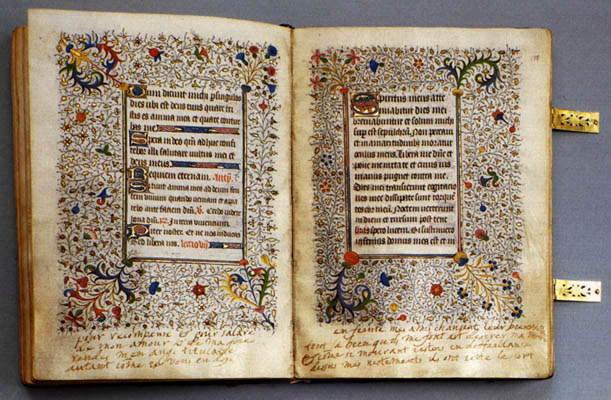 |
| Mary Stuart's Breviary (Photo: Wikipedia) |
I used to think it was wrong to
complain to God. I had overdosed on those stories where saints are
portrayed as positively craving new opportunities to suffer for the
love of God-- bursting into rhapsodies of delight at each new illness,
inconvenience, and disappointment. And so, when the thought would cross
my mind in times of trouble—
God, what on earth were you thinking to let this happen to me?—I thought I was being at least slightly sinful.
But King David and the other psalmists complain plenty. They go on in
great detail about how bad life is at the moment, and ask God why He
hasn't fixed it yet. They tell God they don't understand why He worked
so many miracles in the past but doesn't seem to do so anymore. They
point out that non-believers are suggesting that maybe God is not so
great if He allows such disasters to happen to His friends.
We can't dismiss this by saying, "That was the Old Testament." After
all, the psalms were the prayers that Jesus used. As He was dying,
he cried to His Father with the ultimate complaint from Psalm 22, “My God, my God, why have your forsaken me?”
Psalm 42 shows us the way
Yesterday's Morning Prayer from the
Divine Office (Psalter, Monday Week II) starts with a wonderful example
of the biblical way to complain--Psalm 42. It opens with sheer poetry,
expressing our deepest longing:"Like a deer that years for running streams, so my soul is thirsting for you, my God..."
But soon the psalmist makes it clear that he is pretty miserable:
"My tears have become my bread by night and by day, as I hear it said all the day long,'Where is your God?'"
"I remember...how I would lead the rejoicing crowd into the house of God...the throng wild with joy."
Now, check this out:
"Why are you cast down, my soul, why groan within me? Hope in God, I will praise Him still, my savior and my God." A complete acceptance of suffering? Not quite. After this expression of trust, he is immediately back to complaining.
"Why have you forgotten me? Why do I
go mourning, oppressed by the foe?...my enemies revile me, saying to me
all the day long, 'Where is your God?'"
Despite that, the psalm ends with the refrain,
"Hope in God, I will praise him still, my savior and my God."
Complaining and trust aren't mutually exclusive
The pattern is easy to see. Complain while trusting. Trust while complaining.
This makes perfect sense. In fact, it
is what good (albeit fallen) children will do. Think of that fussy
toddler screaming his head off while clinging to Mom's leg. The
whiny six year old whose favorite phrase is “That's not fair.” Or the
teenager pouting in her room. Despite each age-appropriate version of
“why have you rejected me?” they know that you love them and have their
best interests at heart. Not that they are likely to say, “That's okay, Mom. I trust you, even if you don't buy me an Ipad.” These are
fallen children
we're talking about. But their continued trust is, I think, implicit.
Maybe this is part of what Our Lord meant when He said we should become
like little children.
Of course, it would be better to follow up our complaints to God with
explicitly stated trust in Him. And the psalms are excellent models of
how to do this. Complain. Trust. Repeat.
Daria Sockey originally posted this at her blog Coffee and Canticles.