Our Members' Blogs

Showing posts with label Pride. Show all posts

Wednesday, August 20, 2014

Who is the center of my universe?

By Melanie Jean Juneau

File:Observable universe logarithmic illustration.png

Observable universe logarithmic illustration by
Unmismoobjetivo (Wikimedia Commons).


An interesting question to ask ourselves, “Am I Christ centric or ego centric?”

I was shocked when I discovered that I functioned as if I was the center of the universe.
Shocked because I  really did not grasp that my whole paradigm was skewed.
Shocked because I thought I had given my life to God.
Shocked to understand just how much inner transformation it takes to say with St. Paul,
 Galatians 2:20
I have been crucified with Christ and I no longer live, but Christ lives in me. The life I now live in the body, I live by faith in the Son of God, who loved me and gave himself for me.
 Until we allow our false selves, our egos to die, we  view the world through our eyes with events and other people revolving around ourselves as the centre.
Only surrendering that false self to Christ on the cross can free us from this prison of selfish isolation and plug us into the Mystical Body of Christ.
Then we are free to simply be children of God as we gather with others to worship Christ at the center of all life.
I do not make Christ  the center of my life because Christ isn’t merely the center according to St. Paul, He IS my life!

Colossians 3:4 “When Christ, who is our life, is revealed, then you also will be revealed with Him in glory.”
 Melanie originally posted this at:
 

Wednesday, July 2, 2014

John the Baptist: bridging the Old and New Testaments


By Heidi


June 24 is the Solemnity of The Nativity of Saint John the Baptist.  Today we celebrate the birth of the man who, as Saint Augustine tells us, “represents the boundaries between the two testaments, the old and the new.”  All of the events surrounding the birth of the Baptist suggest that the obscurity of the Old Testament prophesies are to be revealed and illuminated by the one who John is to proclaim, who John had already been proclaiming as he leaped in the womb of his mother Elizabeth at Mary’s arrival.  Leaping like David dancing before the Ark of the Covenant.  Even from the womb John points us past the signs to the ultimate realities.  This is why we celebrate his birth with a Solemnity!

John points us out of the wilderness, out of confusion, to the fulfillment of the words of Isaiah, Hosea, Jeremiah and the prophets.  Words that often were mysterious, and attain their deepest meaning only in the light of Christ’s salvific mission.  And us too, he points us past the mundane to Jesus, in whose light even the most obscure life is elevated and glorified.

Of course evil hates clarity and light.  The enemy of your soul will always try to confuse your vocation, obscure your accomplishments and highlight your failings. Even John the Baptist experienced moments of confusion and doubt as he faced down evil in his martyrdom (Matthew 11:2).  From his place of imprisonment John lived out what he had been preaching to all who would listen:   He turned to the Lord; he asked Him for reassurance and in the Lord’s response he was satisfied.  Even in his doubt he fulfilled his mission which is so beautifully portrayed in so many paintings;  in sending his messengers to Jesus, John was pointing to Him and showing us all the way out of our own confusion and self-doubt.


Continue reading at Journey to Wisdom.

Saturday, May 10, 2014

Is it truth or sophistry?

By Melanie Jean Juneau


http://upload.wikimedia.org/wikipedia/commons/8/89/Brisset_-_Sainte_Madeleine_%C3%A9coutant_le_sermon_du_Christ.JPG
St. Mary Magdalen Listens to
Christ's Teaching
by Brisset
(Wikimedia Commons)


Years ago, I was washing up some pots, just before dinner, when all of a sudden a word popped into my head, seemingly out of nowhere. I turned around and blurted out to my kids, who were doing homework around the kitchen table,

“Sophistry! The word that keeps coming to me is sophistry.”

Of course everyone burst out laughing because no one had a clue what I was talking about or what that word even meant. The word sophistry describes language and logic used by Satan, in Milton’s epic poem Paradise Lost. Sophistry could describe the logic used by a lawyer intent upon persuading a jury to find a criminal not guilty. When the intent of words is not to reveal the truth but to confuse people, the speaker is using sophistry. Sophistry is all too common in out society, from the world of politics to the world of advertising,Modern man uses words to influence people for their own purposes.

Just the other day, the word sophistry popped into my head again because we often resort to sophistry without realizing exactly what we are doing. Words often keep us running in circles and keep us from discovering freedom and truth. Thank God for the power of the Holy Spirit. The word of God cuts through sophistry like a two-edged sword.

My only hope of living in reality, to cut through lies, to see myself  and others in  truth and to embrace truth is by embracing the Word made flesh.Sometimes I might think that I am in the truth or that I am ruthlessly speaking the stark truth to another but if I do not speak with Love, it is still sophistry.  The evil one can speak a condemning truth, a truth without love that seeks to destroy.Only God and those who carry the Love of God speak a liberating truth that heals and sets free.


Melanie originally posted this on her blog joy of nine9.

Saturday, May 3, 2014

Wisdom in prayer

By Beryl Baterina


http://upload.wikimedia.org/wikipedia/commons/d/d2/William_Blake_-_The_Parable_of_the_Wise_and_Foolish_Virgins_-_Google_Art_Project.jpg
The Parable of the Wise and Foolish Virgins By Blake
(Wikimedia Commons).


"This kind can only come out through prayer.” 

Wisdom is God's gift and we can enhance this gift by learning and sharing it.  We can learn more from school, other people, and experiences.  We can share it by means of teaching, encouraging, or inspiring others.  Having the gift of wisdom does not give us the authority to be arrogant about it.  We must be humble and be grateful to the Lord for this gift.

We may excel in our daily jobs or activities but these are all because of God.  We must not be proud and arrogant thinking that it is because of our hardwork that we were able to achieve who we are today.  It is a blessing from God.  We must thank God for all the graces given to us.  And this is praying.  We  must learn to pray that we may be able to properly use these gifts from God.  Everything around us is wonderful and we must see the goodness in them.  We must have this habit of praying to God that we may use all the creation according to His plan.  Without prayer, these great gifts will not be useful to us.    


Continue reading at Beryl's blog Beryl Baterina.

Thursday, April 17, 2014

Where do I stand this night?

By Melanie Jean Juneau


File:Jaume Huguet - Last Supper - WGA11797.jpg
The Last Supper by Jaume Huguet (Wikimedia Commons).


It is Holy Thursday, the night we celebrate the Chrism Mass.Tonight, churches around the entire globe will wait in  prayerful vigil, with lights dimmed, all images covered with the congregation in respectful, sombre silence. The Church is remembering the end of Jesus’ public life as a teacher and healer and walking with Him as He begins His most important work, the work of salvation in His passion, death and resurrection.

Yet today’s Gospel takes us back to the beginning of Jesus’ public ministry. He has just emerged from the desert, filled by the power of the Holy Spirit, astonishing crowds with His words. As He stands on the podium in the synagogue to read from the book of Isaiah, repeating the Old Testament reading which we have just heard minutes before, Jesus summarizes His entire ministry in a few short verses.

The Spirit of the Lord is upon me,
because he has anointed me
to bring glad tidings to the poor.
He has sent me to proclaim liberty to captives
and recovery of sight to the blind,
to let the oppressed go free,
and to proclaim a year acceptable to the Lord.


Continue reading at Melanie's blog Joy of Nine9.

Monday, December 9, 2013

Self-important humility

By Melanie Jean Juneau


Joan of Arc's Death at the Stake by Stilke
(photo credit: Wikimedis Commons)


When many Christians think of  humility and sanctity, they often think of ascetic fasting and the heroic acts of the saints, but these sorts of practices often focus more on self than on God. It is actually a subtle sort of self-delusion that is difficult to discern, but God is finally getting through to me, helping me shake off self-defeating,  pious actions that actually drive me further from God.

“For it is by grace you have been saved, through faith—and this not from yourselves it is the gift of God not by works-Ephesians 2:8,9

I cannot earn His love or Presence.
He must do everything in me.
This is true humility.

Pride entices me to work harder, pray more, fast religiously and perform heroic looking acts of virtue.  Humility accepts that only God can save me and those around me. 

Why?

We must come to the realization that we need a Savior. It usually takes even contemplative monks decades to finally let go of the last of their pride and arrogant striving to humbly surrender control to God. Pride makes us try to earn our salvation with good works. Humility realizes that we are sinners. Period. Nothing can change that fact, except Christ's work on the cross. 
 
Melanie writes at Joy of Nine9.

Wednesday, October 23, 2013

Harsh words from Jesus

By Deacon Paul Rooney


Jesus has some harsh words in today's Gospel for those who do not tend to their spiritual journey.  One road on this spiritual journey speaks to me of love, and our invited response to the ethical demand of the gospel.  The other road speaks to me of hypocrisy.  Both roads reveal themselves eventually.

I can remember vividly the time when I was a paperboy for the Fremont Tribune many decades ago.Every late afternoon during the weekdays I would make my rounds delivering the Tribune.  Then on the first Saturday morning of the month, I would make the rounds collecting the monthly subscription price of 15¢. [How times change…the price today is $12.25 to have it delivered to your door by a paperboy!]

During the daily deliveries all month long, all I would see would be the outside of the homes: all very nicely painted, yards well-trimmed, and so on.  But once a month when I collected, they would invite me inside and I would see the absolute mess or chaos that the homes really looked like inside, away from the eyes of the world.  I suspect many of us can visualize that scene.  How many times have we received a surprise phone call from someone saying they would be arriving soon to visit - - so we hit the panic button and clean up the inside of the house (or at least that part that the Visitor will see)!

This is sort of what Jesus is getting at in today’s Gospel (Luke 11:37-41). Jesus seems to get a little tough with his host, calling him and all the Pharisees fools!! That’s probably not something you would expect an invited person to call you, right in your own home. But that really was in keeping with the rabbinic tradition, which could also be harsh with some Pharisees.  In that culture, it meant that the Pharisees were being seen by Jesus as being arrogant, which in turn means the Pharisees were acting out of self-important pride in their own ability to follow the ritual rulebook.  And their man-made rulebook said that everyone had to wash their hands and forearms before eating.


Continue reading at Journey to Wisdom.

Monday, September 9, 2013

Jesus and the jar of pickles--distractions at prayer

By Amanda Rose


File:Washing of the Feet.jpg
Washing of the Feet (artist unknown; photo credit: Wikimedia Commons).


I admit it. I am not a "morning person." Morning prayer times were not fruitful for me for many years. By "not fruitful," I mean that I would fall asleep whenever I attempted mental prayer in the morning. Even if I was sitting in an uncomfortable pew after morning Mass and wanted to stay for a bit with the Lord, my head would nod and I would startle awake, only to nod off again. I could pray in the afternoon, or late at night and stay awake, but not in the mornings. I read and was told that it was preferable to have a morning prayer time, but I just couldn't stay awake through one!


Well, I have been quite pleased with myself for faithfully praying Morning Prayer from the Liturgy of the Hours the past months – and staying awake. Maybe it's because I pray the Liturgy of the Hours from my phone using the Laudate App and electronics really do keep us awake? Or maybe it's just - cough, cough – middle age? Whatever the grace, I was doing so well that my spiritual director suggested I add the daily Mass readings to my morning prayer time, and that was a nice thought - a little time to meditate on the scriptures before starting the day.  

Maybe I shouldn't have been quite so pleased with myself and my success. After all, Proverbs 16:18 says, "Pride goes before destruction, a haughty spirit before a fall." I was feeling a little proud, kind of full of myself. Should have known better and remembered - it's all a gift, not me at all, whether I am awake or asleep, it's a gift from God. But I forgot and this week in my exuberance I added in a little something extra in the morning instead of waiting til later in the day. I read the verse of Jesus washing the feet of the disciple, meditating on it and praying for the grace of humble servitude.


Read the rest at Amanda's blog Little Steps Along the Way.

Wednesday, September 4, 2013

The dangers of being Catholic

By Rebecca Duncan
 

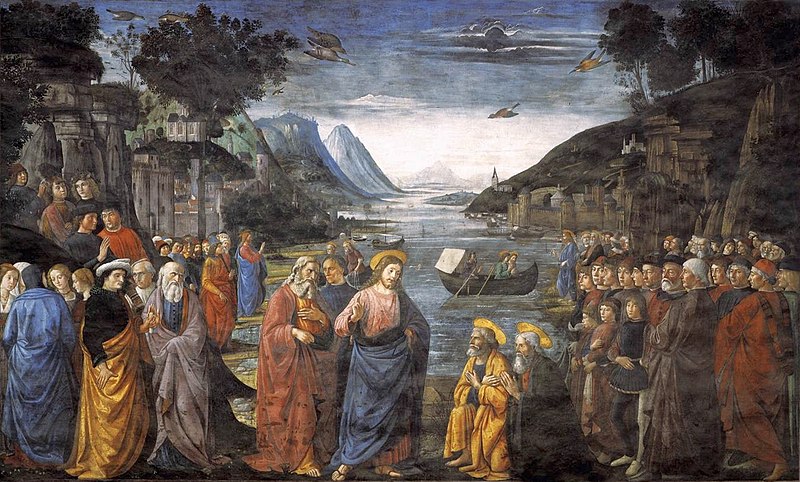
File:Ghirlandaio, Domenico - Calling of the Apostles - 1481.jpg
Calling of the Apostles by Ghirlandaio (photo credit: Wikimedia Commons).


Who were the Pharisees?  What were they really?  Why did Jesus condemn them so much?

They were men who thought they had found God.  They were men who had stopped seeking God and crying out for Him because they thought they already possessed Him.  They were men who were in the true Faith, who carried it out to the letter and who missed the point.  They were men who loved God's law but did not love God.  They were men who read about God every single day but could not see Him standing right in front of them. 

I've been thinking about what it was like before I was converted.  I was seeking God with all of my being.  My whole life was crying out the question, "Who are you?" 

Once I found the answer, I gradually became angry and bitter.  Some of that was rebelling against God's demands on my life.  But there was another dimension that I have only just come to realize.  It was that once I became sure that I knew who God was and that I was safely in His house, I stopped searching for Him.  I became a Pharisee. 

If I am not searching for God, I am most certainly searching for something else.  Whether it is success, entertainment or my own ideas about God and His life, as a human being I must always be seeking for something.  But, I will come to the end of those things.  God is the only one who I will never come to the end of.

Before I became Catholic, my life was filled with a kind of mysticism.  It was only because I was still seeking for God so strenuously.  That should be the perpetual state of this life.  That is how we enter into eternity now because eternity is always seeking and seeing more and more of God and never reaching the end of Him.

No matter where we are in this life we can never stop searching for God with all of our being.  Whether we know His name or not, whether we are praying perfectly or not, whether we are in a habit of sin we can't get out of or not, we must cry out for God like the tax collector who beat his breast and said, 'Lord, have mercy on me, a sinner!'  

The saint is the one who starts searching for God and never stops.


Rebecca blogs at  Otaku Catholic.

Monday, August 19, 2013

Are you a jackass for Christ?

By Deacon Paul Rooney


File:Gdańsk Entry into Jerusalem.jpg
Entry into Jerusalem (artist unknown; photo credit: Wikimedia Commons).


Today I want to share some thoughts with you about Martha and Mary, featured in our Gospel recently, and one aspect of the story that relates to our own personal spiritual journey.

But before I get there, I want to alert you to the fact that I will be using a dictionary word that might sound bad, one that sometimes has bad connotations (depending entirely on how you use it).  However, I assure you that I will be using it only in a good sense, and I will be quoting a pope who also uses it in this same good way.

First, I have a question for you.
 
Have you ever reflected on the truth that "discipleship" really translates into the need for you and me to become "a disciple for others"?  Yes, we are disciples of Christ.  But He devoted His life to others. That is the same mission we have as baptized Catholic disciples of Christ.

But before we can do that, we have to become "intentional disciples" — meaning followers of Jesus who have a living, personal relationship with Jesus, and who order their lives based on that decision to follow him.

So how do we go about acquiring such a personal relationship? The process is simple. We have to be formed and fed by Christ, and only then sent to carry on the mission of Jesus.

It is this exact sequence of things that matters: formed, fed, and then sent. Sure, we can do all kinds of good things in terms of help for the poor. But if it does not flow from our Christ-center, then it is nothing more than secular humanism, just good deeds that have no reference to our faith life, and may even deny or reject the need for Christian faith and our duty to respond to the needs of others.


Continue reading Deacon Paul's post at  Journey to Wisdom.

Wednesday, July 24, 2013

Our biggest delusion

by Melanie Jean Juneau


File:George Inness - Morning - WGA11858.jpg
Morning  by George Inness (photo credit: Wikimedia Commons).


There is a world of difference between a man who is aware of himself, sitting on a hill and looking at a beautiful sunrise and a man so enthralled with that very same sunrise that he forgets himself and becomes  absorbed in the scene. In the first instance the man is egocentric; he is at the center 0f his world, not God

When I see beauty everywhere, I experience joy and a sense of connection because my eyes are not on myself. The truth is that I am simply part of the whole. Everything does not depend on me. I am free to relax and enjoy the beauty of nature and the Spirit of God which permeates all when I am in the right place in the scheme of things.

I am living in a fantasy when I see myself as the center of the universe, viewing everything as it circles around me. As believers we sing and recite prayers that proclaim that God is the center of all but our psychological make-up screams the exact opposite. I view people, events, history and yes even God through my eyes, judging what is right, trusting my thoughts and my feelings as the final judge of what is real. When Jesus says that we must die to ourselves, He is not speaking about some pious self-sacrifice that makes us look holy, no He has something much more radical in mind. The kind of inner transformation Jesus desires literally rips the rug up from under our feet and shatters our world view.

"I have been crucified with Christ and I no longer live, but Christ lives in me. The life I now live in the body, I live by faith in the Son of God, who loved me and gave himself for me" (Galatians 2:20).

Why is modern man so anxious, nervous, out of sorts? Part of the reason is probably that many people barely see a blade of grass during their normal work day. Surrounded by concrete and glass, our innate self craves connection with the rest of the natural world, other people , the communion of saints, (both living and dead) and at an even deeper level, God Himself. Instead we live in isolated, man-made prisons which shut out other human,s never mind other living creatures and God.  Each person is at the center of their little artificial universe. That means that each of us has assumed the role of king or queen of our tiny kingdoms with everything depending on us.

I was never designed to live alone like an island unto myself. Yet, in my pride, I cling tenaciously to my throne and crown. Only when I was completely depleted and shattered, only then did I resign and give God  back His job. Only the did I surrender an ego centric point of view and embraced reality which is that God is at the center of the universe and I am simply part of the Mystical  Body of Christ.

Definitely absurd, but I only saw this fact after I surrendered and let go of control. What is really important in life is not found in self-created delusion but discovered as I learn to live in harmony with a bigger universe than the one I created.

"In the total expanse of human life there is not a single square inch of which the Christ, who alone is sovereign, does not declare, ‘That is mine!’" (Abraham Kuyper).

St. John of the Cross (San Juan de la Crux), who lived in the 16th century, explains the inner process of becoming one with Christ:

I lose myself and remain,
With my face on the Beloved inclined;  
All has come to rest,  
I abandon all my cares  
There, among the lilies, to die.

 Melanie Jean Juneau blogs at  Joy of Nine.